Tutorial
Example 1: C1s XPS calculation of 3,3,3-Trifluoropropanol
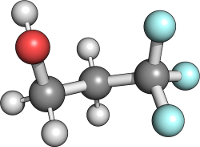
For 3,3,3-Trifluoropropanol one would expect three distinct C1s signals in the XPS spectrum, each signal can be assigned to one carbon atom in the molecule.
The central quantity one has to calculate when simulating XPS spectra are the so-called core-electron binding energies (CEBEs). These can be obtained via a \(\Delta\)-Kohn-Sham calculation. The CEBE for an excitation center i is given as \(CEBE = E^{i}_{kat} - E_{neu}\), where \(E_{neu}\) and \(E_{kat}\) are the energies of the neutral and core-ionized molecule, respectively.
In this example, we are calculating the core electron binding energies with B3LYP/def2-TZVP. In order to get the energy of the neutral molecule, we can use the following input:
import psixas

memory 16GB

molecule{
C           -0.348376548098    -0.548474458915    -0.927836216945
C            0.598339605925     0.344412190721    -0.154926820251
C           -1.260377523962    -1.428990131337    -0.073815750620
H           -0.931459004013     0.095187059173    -1.591052058736
H            0.270520314607    -1.188949646350    -1.560246367799
F           -0.030731307342     1.342027128065     0.491810630465
F            1.492395966346     0.923480284909    -0.991220902737
F            1.309169804186    -0.344637834439     0.762302565414
H           -1.792305519830    -2.113716429507    -0.745127437896
O           -2.163746992897    -0.714605675932     0.750272586920
H           -0.660551886505    -2.035740348426     0.604285075819
H           -2.747844602396    -0.181104236356     0.200201028032
symmetry c1
}

set {
basis def2-TZVP
}

set psixas {
prefix TRIFLUOR
MODE GS
}

set scf {
reference uks
scf_type MEM_DF
}
energy('psixas',functional='B3LYP')
By the end of the calculation, a Molden file is written, which can be used to identify the carbon 1s orbitals. In this case they have the indices 4,5 and 6 (if one starts counting at 0). To calculate the energies of the core ionized states, one can start a calculation in a separate directory (the TRIFLUOR_gsorbs.npz can be copied so that the calculation restarts), or one simply modifies the input file. The following input can be used to simulate the ionization from orbital 4:
import psixas

memory 16GB

molecule{
C           -0.348376548098    -0.548474458915    -0.927836216945
C            0.598339605925     0.344412190721    -0.154926820251
C           -1.260377523962    -1.428990131337    -0.073815750620
H           -0.931459004013     0.095187059173    -1.591052058736
H            0.270520314607    -1.188949646350    -1.560246367799
F           -0.030731307342     1.342027128065     0.491810630465
F            1.492395966346     0.923480284909    -0.991220902737
F            1.309169804186    -0.344637834439     0.762302565414
H           -1.792305519830    -2.113716429507    -0.745127437896
O           -2.163746992897    -0.714605675932     0.750272586920
H           -0.660551886505    -2.035740348426     0.604285075819
H           -2.747844602396    -0.181104236356     0.200201028032
symmetry c1
}


set {
basis def2-TZVP
}


set psixas {
prefix TRIFLUOR
MODE GS+EX
ORBS   [4]
OCCS   [0.0]
SPIN   [b]
FREEZE [T]
OVL    [T]
}


set scf {
reference uks
scf_type MEM_DF
}
energy('psixas',functional='B3LYP')
The MODE is set to GS+EX. This requests a ground state Kohn-Sham (neutral) as well as an excited state Kohn-Sham calculation (in this case a cation). The ORBS keyword sets the index of that orbital, whos occupation number is modified. OCCS and SPIN set the new occupation number and the spin of the orbital. FREEZE and OVERLAP indicate that the core orbital is frozen during the SCF and that the algorithm tries to find it by an overlap criterion. The following lines of the output are important:
FINAL EX SCF ENERGY: -481.33260783 [Ha]
EXCITATION ENERGY:  10.97109328 [Ha]
EXCITATION ENERGY: 298.53864318 [eV]
where the last line gives us the core electron binding energy. The other CEBEs can be calculated similarly, only the OCCS keyword needs to be modified (to 5 and 6).
| Carbon | CEBE [eV] |
| \(\mathrm{CF_3}\) | 298.5 |
| \(\mathrm{CH_2OH}\) | 293.2 |
| \(\mathrm{CH_2}\) | 292.2 |